

Every day on Reddit, someone writes "we tried X and it's too expensive, what else is out there?" in a subreddit where your product would be the obvious answer. Nobody from your company sees it. A competitor's founder does, replies two hours later, and gets the customer.
That is what lead generation on Reddit actually is: people thinking out loud before they buy something, and the whole game is being in those threads early, being useful, and not looking like a salesperson.
This guide is the system we recommend to RedShip users: what counts as a lead, where to find them, how to throw away the noise, and how to reply so the thread turns into a customer instead of a ban.
What counts as a lead on Reddit
Most people start with the wrong definition. Someone who mentions your category is not a lead. Someone who complains about your competitor on a thread from 2021 with no Google traffic is not a lead either.
A lead on Reddit has three things:
- A problem you solve, described by the person who actually has it.
- A decision in progress: they are looking for a way out, comparing options, or asking what others use.
- A thread you can still reply to: either it is fresh, or it ranks on Google and keeps getting read.
Within that, intent varies a lot. The way the post is phrased tells you how close the person is to buying and what your reply should do.
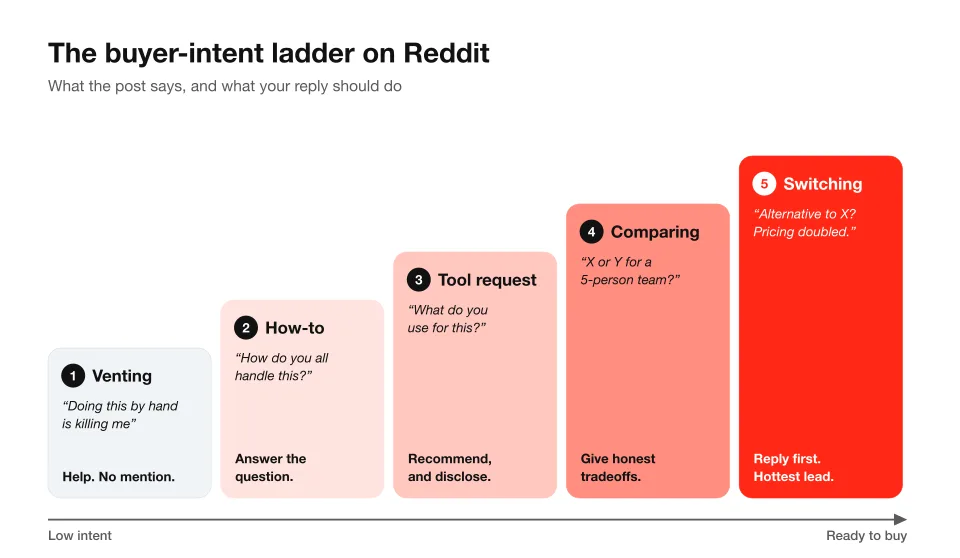
The two top rungs are where customers come from. Switching posts ("alternative to X, their pricing doubled") are the hottest leads on Reddit: the person has a budget, knows the category, and has already decided to leave. Comparison posts come right after. Tool requests are great too, as long as your product genuinely fits the use case they describe.
The lower rungs still matter. A good answer to a "how do you handle this?" post, with no mention at all, is how people start recognizing your username. Some of them come back later with a tool request of their own.
Step 1: Write down the phrases your buyers use
The biggest mistake is monitoring your product category. If you sell a scheduling tool, tracking "scheduling software" brings you ads, listicles and vendors talking to each other. Buyers rarely write like that. They write like this:
| Pattern | What it sounds like | Intent |
|---|---|---|
| Switching | "alternative to [competitor]", "moving away from [competitor]", "[competitor] got too expensive" | Very high |
| Comparing | "[tool A] vs [tool B]", "is [tool] worth it", "anyone regret [tool]" | High |
| Asking for a tool | "what do you use for", "any recommendations for", "is there an app that" | High |
| Stuck on the problem | "how do you handle", "doing this manually", "there has to be a better way" | Medium |
| General talk | your category name, industry news, "is X dead" | Low |
Build your list from three sources:
- Your competitors. Their names plus "alternative", "vs", "pricing", "cancel" and "review". This is where the switching threads come from.
- Your customers' words. Sales calls, support tickets and onboarding answers. Copy the exact phrasing people use to describe the problem, typos included.
- Reddit itself. Search your problem and read how people phrase it. Our free Reddit Keyword Research tool shows which phrasings actually get used and in which subreddits.
Keep the list short at first. Ten good phrases beat a hundred generic keywords, because every keyword you add also adds noise you will have to read.
Step 2: Find where those conversations happen
There are two kinds of Reddit leads, and they need two different habits.
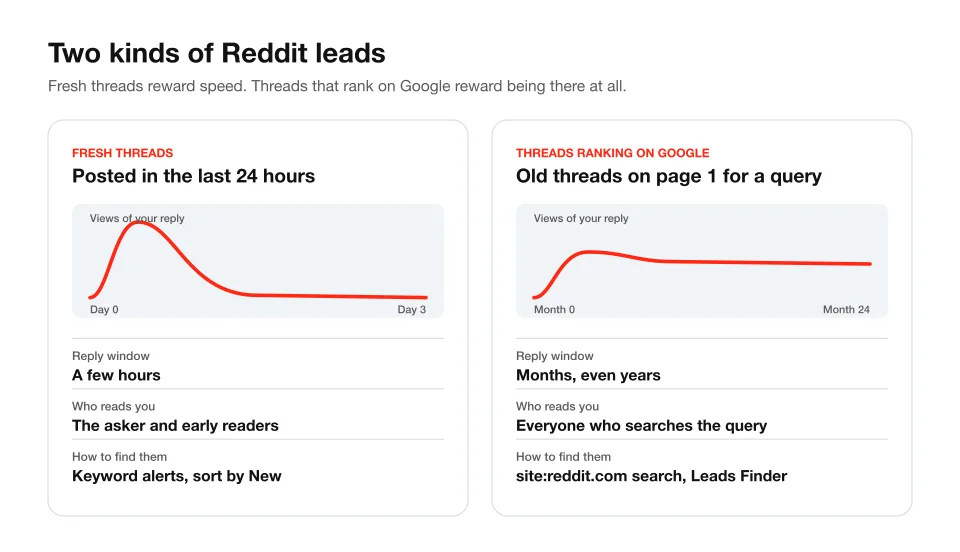
Fresh threads: speed wins
A new post gets most of its attention in the first hours. The asker reads the early replies, votes on them, and often picks from them. A great answer posted the next evening lands under twenty others and nobody scrolls that far.
To catch fresh threads:
- Search your phrases on Reddit, sort by New, and filter to the past 24 hours.
- Check the subreddits where your buyers hang out, not only the obvious ones. Smaller, specialized communities often have more intent per thread and fewer competing replies. The Subreddit Finder helps you find them from a topic, and this list of subreddits where buying conversations happen is a good starting point.
- Or set up keyword alerts so the threads come to you by email or Slack instead of you checking every few hours. We compared the options in our guide to Reddit alerts.
Threads that rank on Google: be there at all
This is the half most people ignore. Google shows Reddit threads on page one for a huge number of "best X for Y" and "alternative to X" searches. Those threads keep getting read for months or years, and every reader is someone who searched for exactly your problem.
The original poster may never come back, but a helpful reply at the top of a thread that ranks is a recommendation seen by every future searcher. We wrote a step-by-step method to find Reddit threads that rank on Google. The short version is a Google search like site:reddit.com "alternative to [competitor]".
Or skip the manual part. Paste your website below: the tool reads what you sell, generates the phrases your buyers would use, and returns the Reddit threads that already rank on Google for them, grouped by subreddit.
Step 3: Filter out the noise
Here is the part nobody warns you about. When you start tracking keywords on Reddit, most of what comes back is useless: the other meaning of your keyword, vendors promoting themselves, job posts, memes, questions from people who will never buy anything.
So the skill that matters most is saying no quickly. Before you spend five minutes on a reply, ask four questions:
- Is this a person with the problem? Vendors, recruiters and people summarizing a trend don't count.
- Is there a decision in progress? Look for past or present pain ("we're using X and..."), deadlines, team size, budget. The body of the post often reveals intent the title hides.
- Can the reply still be seen? A fresh thread, or an older one that ranks on Google. A dead thread from last year with no search traffic is not worth it.
- Can you help without mentioning your product? If the only useful thing you can say is "use my tool", skip it. That comment gets downvoted and hurts your account.
If a thread passes all four, place it on the ladder above. That tells you whether to mention anything at all.
Step 4: Reply fast, and help before you mention anything
The reply is where most founders lose the lead. The instinct is to pitch, and Reddit punishes pitching harder than any other platform: downvotes, removals, and in the worst case a ban from the subreddit.
A reply that converts has four parts:
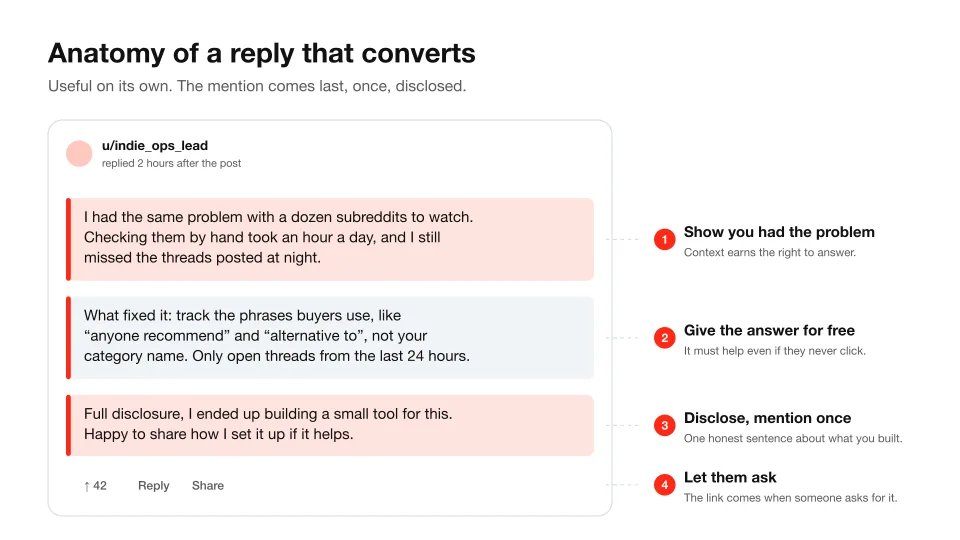
- Show you had the problem. One or two sentences of context. It tells the asker you are not guessing.
- Give the answer for free. The part they can use today, even if they never look at your product. This is what earns the upvotes and the trust.
- Disclose and mention once. "Full disclosure, I built a tool for this" is enough. Say who it is for, and who it is not for. Honesty about fit reads as credibility, not weakness.
- Let them ask. No link in the first reply unless the subreddit allows it and the person asked for tools. When they reply "what's it called?", that is your permission.
Two more things that separate the replies that convert:
Answer the question they asked, not the one you wish they asked. If someone needs a tool for a five-person team with no budget, recommending your enterprise plan is noise, even if it technically solves the problem. Recommending a free option and mentioning yours as the step up is what gets remembered.
Don't jump into DMs. Sending a private message to someone who posted publicly feels intrusive to most Redditors, and many subreddits ban it outright. Wait for them to ask, or for the thread to invite it. We covered the exceptions in our Reddit DM strategy for B2B.
If you want wording to start from, we collected Reddit comment templates that convert, with before-and-after examples.
Step 5: Make it a 15-minute daily routine
Reddit lead generation works on consistency, not intensity. Three good replies a day for two months beat a weekend of thirty replies followed by nothing.
A routine that fits in a morning coffee:
- Open the new matches from the last 24 hours (search, saved searches or alerts).
- Throw out everything that fails the four questions. This takes minutes once you have done it for a week.
- Reply to the two or three best threads, top rungs of the ladder first.
- Answer the replies to yesterday's comments. Follow-up questions are where people ask what you built.
- Log what happened: the thread, the subreddit, whether it led to a click, a signup or a conversation.
The log matters more than it looks. Reddit leads rarely show up cleanly in analytics: someone reads your comment, doesn't click, and searches your name three days later. They land as "direct" traffic. Add a "How did you hear about us?" field to your signup and you will see how much of that traffic was Reddit (more on why Reddit traffic converts differently).
We laid out a complete version of this in a simple Reddit routine for founders.
When doing it by hand stops working
Manual search is the right way to start. You learn what a real lead looks like in your market, which subreddits matter and how your buyers phrase things.
It breaks at a predictable point: more than a handful of subreddits, or more than one product. You start missing the threads posted at night, the posts where the buying intent is in the body and not the title, and the old threads that rank on Google.
That is the problem we built RedShip for. It tracks your buyer phrases and competitors across Reddit, scores every post and comment from 0 to 100 on how close the person is to buying, sends the best ones to your inbox, email or Slack, and drafts a reply you edit and post yourself. It never posts or sends DMs for you, which is also why it doesn't get accounts banned.
It isn't the only option. We compared the main Reddit lead generation tools, grouped by how they work, including the ones that post for you and why that carries more risk.
Where to go from here
Start small this week. Pick your three closest competitors, write down ten buyer phrases, run your site through the leads finder above, and reply to the three best threads you find. If you sell to businesses, our playbook on Reddit B2B lead generation goes deeper on subreddits and decision-makers, and agencies should read how agencies find clients on Reddit.
The founders who get customers from Reddit are rarely the best writers. They are the ones who show up in the right threads, every day, and say something useful before anyone else does.