

Somewhere on Reddit right now, someone is asking for a tool like yours, complaining about your competitor, or mentioning your brand. Reddit won't tell you. There is no "notify me when someone says X" button, and by the time you find the thread by hand, the conversation is over.
Monitoring Reddit is how you hear those conversations while you can still answer. It matters more than it used to: Reddit threads rank on Google for years, and AI assistants like ChatGPT and Perplexity cite them when people ask for recommendations. A useful reply in the right thread keeps working long after you post it.
This guide covers what to track, the six ways to get Reddit keyword alerts (free and paid), how to set up keywords that don't flood you, and which setup fits your stage.
What to monitor on Reddit (and what to skip)
The keyword you think of first is usually the worst one. Tracking your category word ("crm", "invoicing", "analytics") brings you job posts, memes, news and vendors talking to each other. The keywords that pay off sit higher on the intent axis and lower on the noise axis.
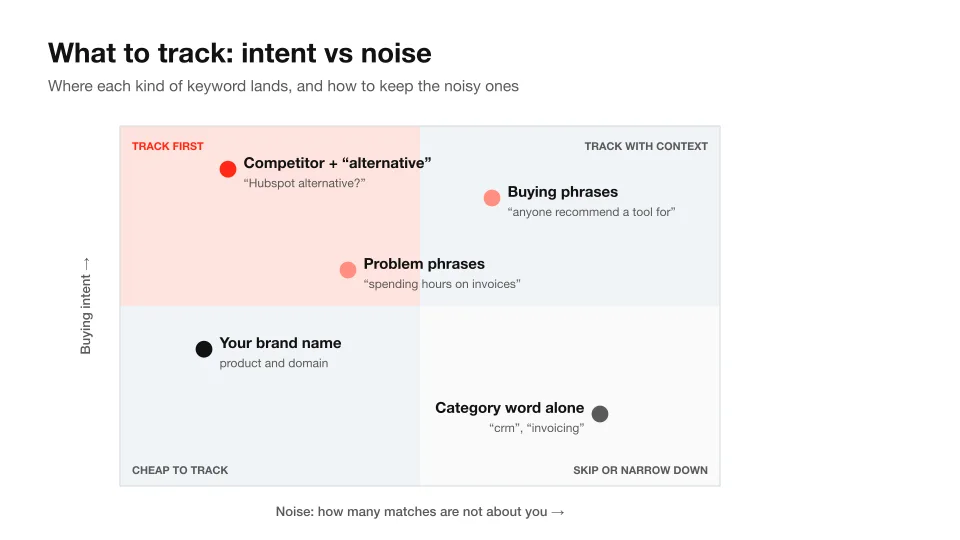
- Competitors plus buying words. "[competitor] alternative", "[competitor] vs", "[competitor] pricing". Few matches, and almost all of them are people deciding what to buy. Start here.
- Problem phrases. How your customers describe the pain in their own words: "spending hours on invoices", "our spreadsheet keeps breaking". Great intent, some noise.
- Buying phrases. "Anyone recommend a tool for", "what do you use for". High intent, but they need your category next to them or they match everything.
- Your brand name. Cheap to track and important for reputation, as long as your name isn't a common word.
- Category words alone. Skip them, or only track them with context and exclusions (more on that below).
If you are tracking competitors specifically, our guide to tracking competitors on Reddit goes deeper.
6 ways to monitor Reddit for keywords
Here is how the options compare on what matters: what they cost, whether they catch comments (where many mentions happen), how fast they are, and how much sorting they leave to you.
| Method | Cost | Catches comments | Speed | Noise filtering |
|---|---|---|---|---|
| Reddit search, by hand | Free | Yes, in the Comments tab | Whenever you check | None |
| RSS feeds | Free | No, search feeds cover posts only | Your reader's refresh rate | None |
| Google Alerts | Free | Rarely | Hours to days | None |
| Zapier, IFTTT or Make | Your automation plan | Zapier's search trigger covers posts only | Minutes to an hour, depending on the plan | Filters you build yourself |
| F5Bot | Free, paid from $9.99/mo | Yes | Within 2 hours free, 5 minutes paid | Keyword filters on paid plans |
| AI monitoring tools | From about $30/mo | Yes | Minutes | Relevance scoring |
1. Reddit search, by hand
The free baseline. Search your keyword in quotes, sort by New, and limit the time range to the past day. Check the Comments tab too, because a lot of recommendations happen in replies, not in post titles. To stay inside one community, use the search bar on that subreddit's page.
It works well when you are learning your market: you see how people phrase things and which subreddits matter. It breaks as soon as you forget to check, or track more than a handful of keywords.
Reddit itself has no keyword alerts. The app can notify you about communities you follow, but it decides which posts to show. Reddit Pro, Reddit's free toolkit for businesses, lets you track keywords in a dashboard, which is useful for spotting trends. It is still a place you visit rather than an alert that comes to you.
2. RSS feeds
Most Reddit pages have an RSS version. Add .rss and paste the URL into a feed reader like Feedly or Inoreader, or into Slack's RSS app:
https://www.reddit.com/search.rss?q=%22your+keyword%22&sort=new
https://www.reddit.com/r/SaaS/search.rss?q=crm&restrict_sr=1&sort=new
https://www.reddit.com/r/SaaS/new/.rss
Free and automatic, with two real limits. Search feeds only match posts, so comments that mention your keyword never show up. And Reddit throttles unauthenticated requests, so some readers fall behind or get blocked. We listed every feed URL and its limits on our Reddit RSS and JSON feeds page.
3. Google Alerts
Create an alert for site:reddit.com "your brand" and Google emails you new results. It is free and takes a minute.
In practice it is the weakest option for Reddit. Google Alerts only reports pages Google has already indexed, which can take hours or days for a new thread, and comments deep in a thread rarely surface. Use it as a backup for your brand name, not as your main system. The detailed comparison of Google Alerts and Reddit monitoring tools explains why.
4. Zapier, IFTTT or Make
Automation tools can watch Reddit for you. Zapier's Reddit app has a "New Post Matching Search" trigger, which you can connect to Slack, email, a Google Sheet or Discord. Add a filter step to drop posts with words you don't want.
It is flexible and fast enough (Zapier checks every 1 to 15 minutes depending on your plan). The limits: that trigger covers posts, not comments, every match counts as a task on your Zapier bill, and building good filters is on you.
5. F5Bot
F5Bot has sent free keyword alerts for Reddit, Hacker News and Lobsters since 2017, and it covers both posts and comments. The free plan gives you 5 keywords and up to 10 alerts a day per keyword, delivered within 2 hours, for personal use. Paid plans start at $9.99 a month for 20 keywords and 5-minute alerts, and Slack or Discord delivery starts on the $49.99 plan.
It is the best free option for a brand name. For broader keywords, you get every match with little filtering, so the inbox fills up fast. If you have outgrown it, we compared the best F5Bot alternatives.
6. AI monitoring tools
The last category reads each match before it reaches you. Instead of "your keyword appeared", you get "this person is asking for a tool like yours", with the irrelevant matches filtered out.
Tools differ in approach. Syften (from $29.95 a month) uses boolean filters across 15+ communities and delivers in under a minute. RedShip focuses on Reddit: it scores every post and comment from 0 to 100 for relevance to your product, sends the best ones by email or Slack within minutes or as a daily digest, and drafts a reply you edit and post yourself. We keep an up-to-date comparison of the best Reddit monitoring tools, including pricing.
How to set up keywords that don't flood you
Whatever method you choose, the keyword setup decides whether alerts are worth opening. The same word can bring you a lead, a job ad and an AMA about something else entirely.
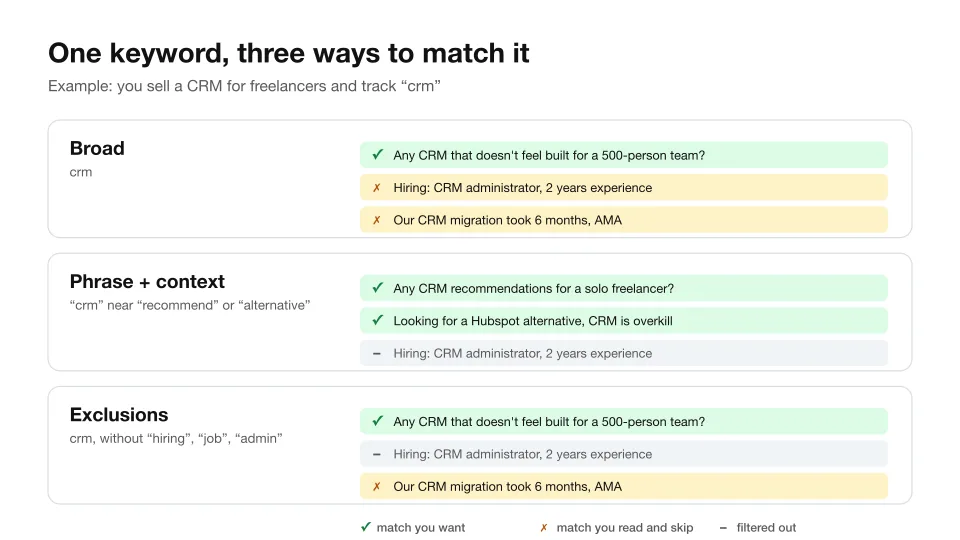
Five rules that keep the volume manageable:
- Quote multi-word phrases. "invoice software" matches the phrase, not every post with "invoice" and "software" somewhere.
- Add context to broad words. Track "crm" only near words like "recommend", "alternative" or "switching", or only in subreddits where your buyers are.
- Exclude the usual noise. "hiring", "job", "salary", "meme", and the other meanings of your keyword.
- Watch out for short or common brand names. If your product is called "Notion" or "Linear", track the domain and "[brand] app" instead of the bare word.
- Review after a week. Keep the keywords that brought real conversations, narrow the noisy ones, delete the silent ones.
The fastest way to test a keyword is to search it before you set up the alert. Paste it below and look at the first page of results: if most of it is noise, your alerts will be too.
Where to send your Reddit alerts
Not every keyword deserves an interruption. Match the channel to the intent:
- Real time, in Slack or by email, for competitor alternatives and buying phrases. Those threads get answered within hours, and the first useful replies get the most attention. See how Reddit alerts in Slack work.
- A daily digest for your brand name and problem phrases. You read them once, with coffee, and reply to the few that matter. More on Reddit email alerts and digests.
- An RSS reader for research: watching how a community talks, not replying.
Which setup fits you
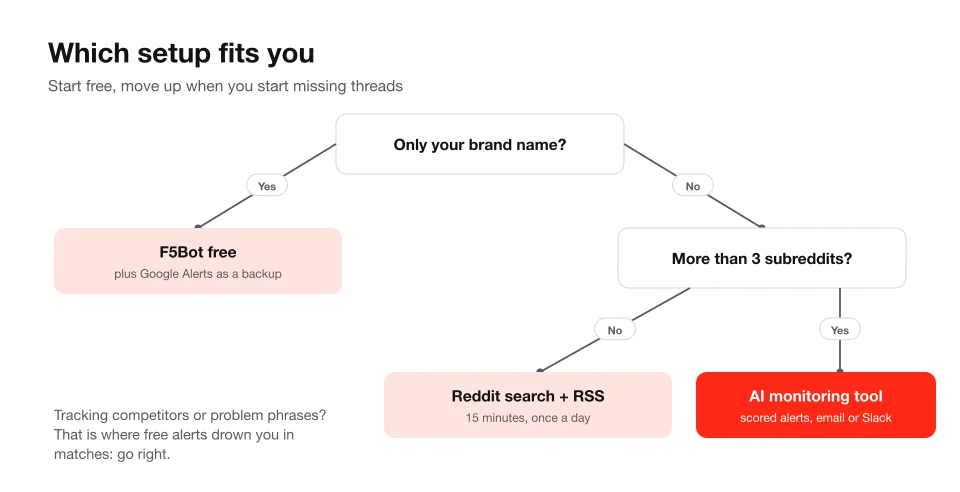
- You only care about your brand name. F5Bot's free plan, with a Google Alert as a backup. Total cost: zero.
- A few keywords in a few subreddits. Reddit search and RSS feeds, checked in a fixed 15-minute window each day. Our simple Reddit routine for founders shows how to keep it that short.
- Competitors, problem phrases, or more than a handful of subreddits. This is where free alerts bury you in matches. A tool that filters for relevance is what makes the daily review stay short.
What to do when an alert comes in
Monitoring is only useful if you act on it. Open the thread quickly, decide whether the person actually has a problem you solve, and answer the question before you mention anything you built. Two guides help with that step: how to find leads on Reddit and the Reddit self-promotion rules to check before you post.
And don't forget the older threads. Some of the best places to be are threads that already rank on Google for your keywords: no alert will ever fire for them, but they keep getting read every day.